REMEMBERING R. GANASA MURTHI
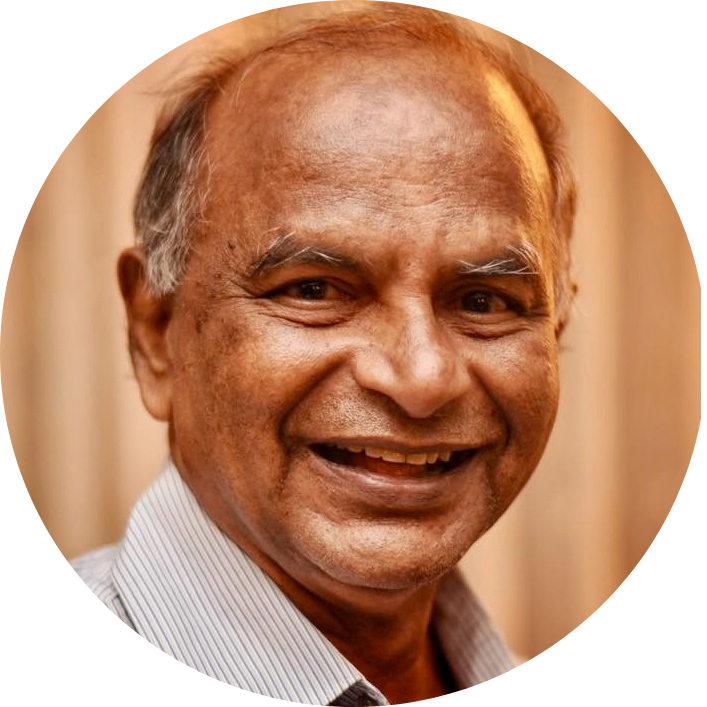
REMEMBERING R. GANASA MURTHI
30 August 1947 – 29 April 2021
31 May 2021
The Spiritual Assembly of the Bahá’ís of Malaysia
Dear Bahá’í Friends,
The Universal House of Justice was saddened to learn from your email letter dated 3 Jamál 178 (29 April 2021) of the passing of Ganasa Murthi Ramasamy, steadfast believer in Bahá’u’lláh. His many years of service, including as a member of your Assembly and the Auxiliary Board, as well as a tireless promoter of the Faith in the several countries to which he pioneered, are warmly recalled. Kindly convey to his wife and children as well as other family members and loved ones the heartfelt condolences of the House of Justice for the loss they have suffered and assure them of its supplications in the Sacred Shrines for the progress of his illumined soul throughout the worlds of God and for their peace and tranquility at this time of bereavement.
With loving Bahá’í greetings,
Department of the Secretariat
THE UNIVERSAL HOUSE OF JUSTICE
Profiled here is a narration of one of the strongest stalwarts of the Faith in Malaysia, who for close to 60 years since accepting the Faith had set an unprecedented record of service, quite unparalleled in many ways.
It was in 1963, during the last year of the Ten Year Crusade (1953 – 1963) period that Ganasa Murthi Ramasamy fondly called Ganesan accepted the Faith. At that time his family was living in Jalan Pintu Sepuloh, Alor Star. Ganesan and Kung Hong Hai were classmates in both Primary and Secondary Schools. As soon as Kung Hong Hai accepted the Faith, he voluntarily guided Ganesan into the Cause, by persuading him to come for Bahá’í meetings in his home in Anak Bukit. It was also at this time that Ganesan, aged 15 and studying Form Three was on the lookout to purchase rattan-made school bag. He approached Mr. Luke Lee Sim Poi, a visually impaired Bahá’í who was weaving school bags at his home. Ganesan saw a pamphlet on the table of his house, located along the same street as his house. When Ganesan asked what the pamphlet was all about, Luke Lee said it was about the Bahá’í Faith and asked him to read it. It was at this time too that Ganesan then happen to meet one Kathiresan who had moved into Anak Bukit from Balik Pulau in Penang to work as a clerk at the government rice mill. The officer-in-charge of the rice mill was Mr. Kung Kim Teow whose family had already accepted the Faith. Mr Kathiresan and the Kungs were an initial group of Bahá’ís in Anak Bukit. He gave Ganesan a good introduction to the Bahá’í Faith. Some days later Luke Lee invited Ganesan to go to the residence of Mrs. Theresa Chee, the eldest daughter of Yankee Leong, the first believer in Peninsula Malaya. Both Ganesan and Yin Hong Shuen, students of the Sultan Abdul Hamid College turned up at the residence of Theresa Chee. Once having become closely associated with Theresa, she took both of them in her car for a Bahá’í gathering at the home of the ‘Kungs’ in Anak Bukit. While sitting under an amara fruit tree at the home of Mr. Kung, Theresa Chee suddenly invited Yin Hong Shuen to speak on “How the world could be united and one world language for the world.” Even as a non-Bahá’í Yin Hong Shuen spoke with so much eloquence, that Theresa told Ganesan, “This is what the Bahá’í Faith is all about. Why not you accept the Bahá’í Faith?” Hong Shuen posed the question to Ganesan and asked, “What shall I do?” Ganesan said, “If you sign up I too will sign up.” Both Hong Shuen and Ganesan consulted with each other, and they accepted and became Bahá’ís on 9 March 1963. Theresa told them that they had just signed up on pink coloured declaration cards meant for youth to be sent to the Regional Spiritual Assembly of South East Asia, at a time when there was no National Spiritual Assembly in then Malaya. Theresa also told them that at the age of 21 they will be signing in the Bahá’í Declaration cards for adults. But they never signed in the adult cards when attaining the age of 21. By that simple act of signing in the Bahá’í Declaration card, little did they realize that they were destined to play crucial roles in the development of the Faith since the early days of the Faith in Malaysia. Thus, Yin Hong Shuen and Ganesan joined Kung Hong Hai, the eldest son of Kung Kim Teow, as the earliest youth to accept the Faith in the premier Sultan Abdul Hamid College. At the time of them accepting the Faith there were only a few youths and families in Alor Star. Ganesan and Yin Hong Shuen had always considered Theresa Chee as their spiritual mother.
Hong Shuen and Ganesan started frequenting the home of Mrs. Theresa Chee, at 1255, Jalan Pegawai, Alor Star. Both of them cycled up to attend several fireside meetings at her home and this was where they met prominent speakers such as Mr. Vicente Sameniago from the Philippines, Mrs. Shirin Fozdar from Thailand, Mr. Yankee Leong from Seremban, Mrs. Shantha Sundram from Penang among others. In stages both Hong Shuen and Ganesan found themselves swept into a whole new world with friends and acquaintances stretching the globe!
In June 1963, Mr. S. Nagaratnam, a teacher and prominent unionist and a radical atheist accepted the Faith after having investigated it for a while. Following the transfer of Mrs. Theresa to Ipoh at the end of 1963 the residence of Nagaratnam at the Sultan Abdul Hamid College compound was used as the Bahá’í Centre. That was the time when many of the students from the college accepted the Faith. Nagaratnam used to conveniently hold deepening classes and firesides at the teachers’ quarters of Sultan Abdul Hamid College. That quarters became a center of immense activities, with constant visits by Bahá’ís from Alor Star and outstation, sometimes even at the wee hours of the night. Nagaratnam was truly a towering figure in the community. After Theresa Chee, it was he who helped lay a strong foundation for Ganesan and the other early believers. Through his guidance and steadfast spirit, he stood as a pillar of strength and inspiration for the growing community. Nagaratnam was the one who initially charted the teaching plans for the local youths and requested them to cycle to those places to teach the Faith.
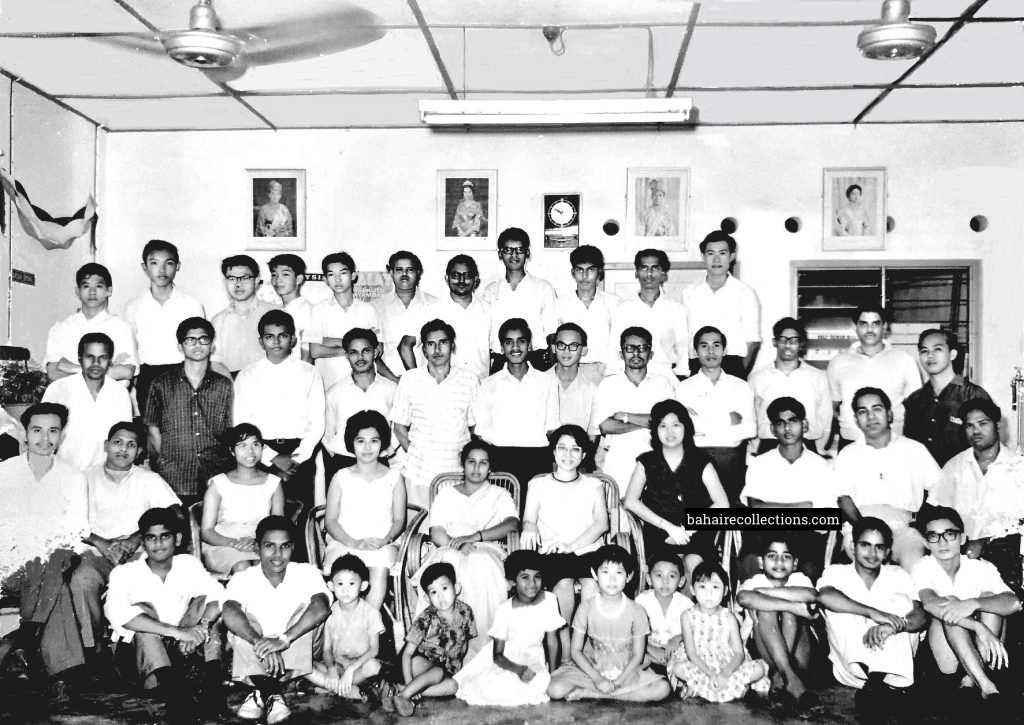
December 1963 – farewell for Mrs. Theresa Chee leaving for Ipoh, seated sixth from left, with Mrs. Rajambaal Nagaratnam to her right. Nagaratnam is seated third from right. Phung is standing at the extreme right. Standing second from left at back row is Choo Yeok Boon with Mei Siew Hong standing at extreme right in the same row. Seated on the floor from right are Yin Hong Shuen, R. Ganesan and V. Manoharan.
Soon Ganesan and Hong Shuen were on fire with the love of Bahá’u’lláh and were obsessed with the thought of teaching the Faith. They started off in their college itself. Teaching the Faith was their main agenda at most gatherings. Picnics were often organized to attract the young ones to attend. Hong Shuen was an influential leader at school level and had a lot of friends. Among those close to him were the members of the Speedo Boys Club, a club at the school, founded and led by Hong Shuen himself. After embracing the Faith, Ganesan’s life was transformed by its spirit and teachings. His sincerity and devotion became a source of inspiration at home. Through his example and loving encouragement, he guided his entire family into the light of the Faith. Ganesan, was the eldest in his large family of 10 siblings. Together with his parents, all the 12 of them lived under the same roof in a modest home. His father Mr. Ramasamy was earlier the headmaster of the Thiruvalluvar Tamil School in Anak Bukit which was started by him in 1948. He then became a senior teacher at the Public Tamil School in Alor Star. When Ganesan accepted the Faith, his siblings were actively attending Bible classes and church activities at the Baptist Church in Alor Star, near the Rex Cinema theatre, while residing at Jalan Pintu Sepuluh. Following Ganesan’s acceptance of the Faith, he started to bring his younger siblings to the Bahá’í Centre for children’s classes. They attended these children’s classes in all the three successive Baha’i Centres in Alor Star at 66, Jalan Teluk Wanjah, then 44, Jalan Teluk Wanjah and finally at the current Bahá’í Centre at 7, Jalan Serai. In stages they all accepted the Faith. His brother Kanthakumar accepted the Faith on 12 August 1964; his sister Vasugi on 11 March 1967; his brother Gunasegar on 19 October 1968; his sister Vijayalechumy on 4 June 1970; his sister Kalavathy on her birthday on 20 August 1971; his brother Jayagopan on 28 September 1973; his sister Saraswathy Devi on 23 December 1974; his brother Ambigaibalan on his birthday on 21 May 1978; and his sister Ambigai Jothee on 21 September 1982. By the grace of the Blessed Beauty, they all married strong and active Bahá’ís, and till this day are actively serving the Cause in their own ways. This family emerged as one of the premier families in serving the Cause in this country. Towards the end of his life, Ganesan used to mention with great pride that his greatest happiness was to see all his siblings grow in the Faith and serve the Faith to the best of his expectation. He was also proud that one of his sisters Kalavathy had pioneered to Guyana, married and established herself there and is still serving at her pioneering post.
Ganesan’s Early Alor Star Days
As soon as Ganesan accepted the Faith, there was no turning back. Having understood the spirit and mission of the Bahá’í Faith he wasted no time in plunging into activities and remained an active servant of the Faith till his last breath. When the National Spiritual Assembly of Malaysia was elected in 1964 for the first time, this institution formed a National Bahá’í Youth Council for this country, with Ganesan and Hong Shuen and Choo Yeok Boon who were fondly called the “Three Musketeers” as active members on this committee.
In 1965, these youth also opened up neighbouring towns and rubber plantation settlements or estates. Nagaratnam and Ganesan made frequent visits to Kangar to deepen the local friends there on the Faith. Kangar was the first goal area Ganesan selected for teaching the Faith. Over a period of time, he and Nagaratnam formed seven Local Spiritual Assemblies in the state of Perlis. Sungei Petani town was one more area that was visited often by above mentioned Three Musketeers. They used to cycle all the way from Alor Star to Sungei Petani, a distance of 32 miles to teach the Faith or meet the believers. Ganesan had also borrowed a bicycle and cycled all the way from Alor Star to Penang, covering a distance of 71 miles to visit the family of the Sundrams. In Sungei Petani the “Private High School” became the permanent conference venue for Teaching Conferences from 1965. Ganesan was one of the speakers at these teaching conferences. Koh Ai Lin and Chiang Kim Lin of Malacca opened up Kuala Kangsar town for the Faith in the early 1960s. There used to be one Double Lion Hotel in Kuala Kangsar where all the Bahá’í meetings were held in the mid 1960s. A state level Youth Teaching Conference was held in the Double Lion Hotel in Kuala Kangsar town on 31 July 1966. Ganesan and Hong Shuen hitch-hiked from his hometown Alor Star to attend this conference.
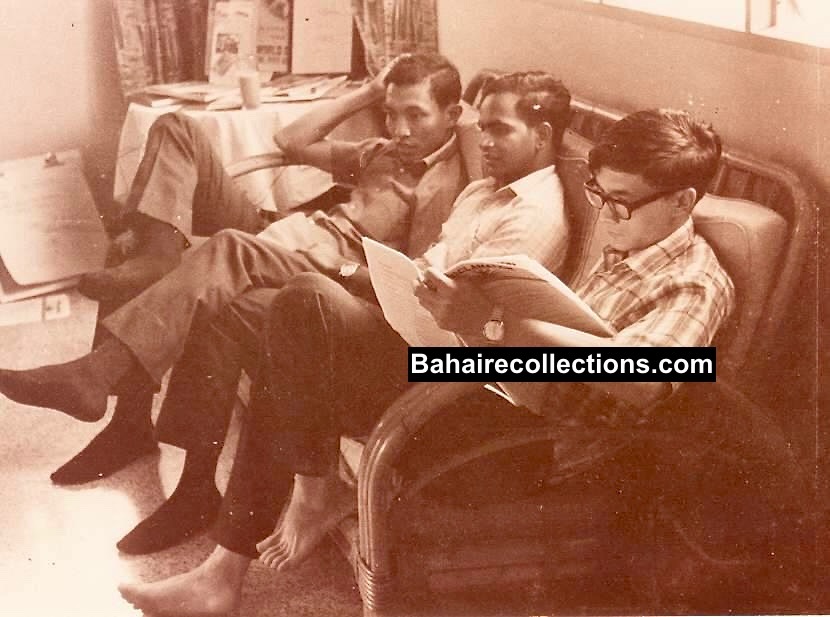
The Three Musketeers. L-R: Choo Yeok Boon, Ganesan and Yin Hong Shuen.
In 1965, Choo Yeok Boon initiated the formation of the first Local Bahá’í Youth Committee in Alor Star. Among the members of the committee were Ganesan, Choo Yeok Boon, Yin Hong Shuen, Kung Cheng Kay and Chandrasekharan Pillai, who was the Secretary of the Committee. The youths had also been active in opening up new areas for the Faith.
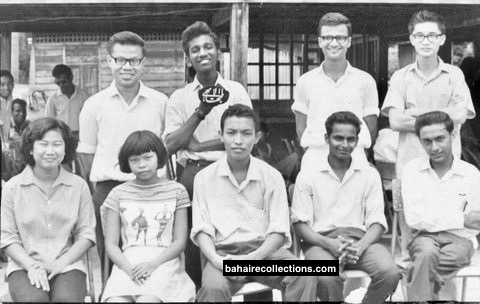
First Bahá’í Youth Committee of Alor Star. Choo Yeok Boon seated in center with Ganesan on his left. Yin Hong Shuen is standing at the extreme right.
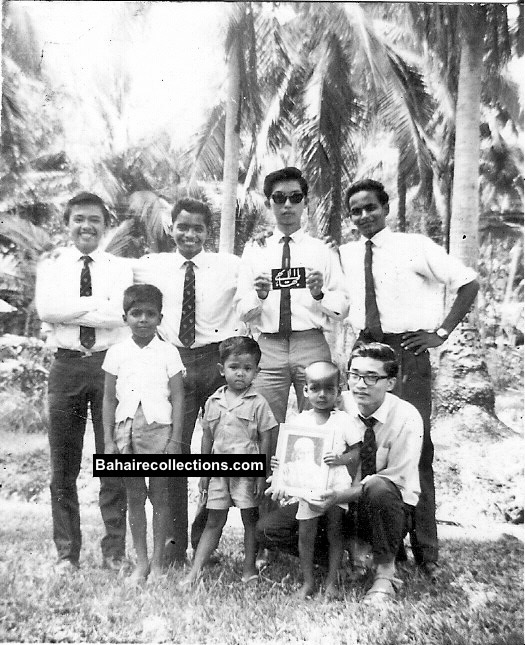
Outside the house of Ganesan at Jalan Pintu Sepuluh the youths were getting ready for Naw-Rúz visit. Back row L-R: Goh Keng Guan, Kantha Kumar,Chew Tian Hock, Ganesan. Front row L-R: Jayagoban, a Malay child, Ambigaipagan and Yin Hong Shuen.
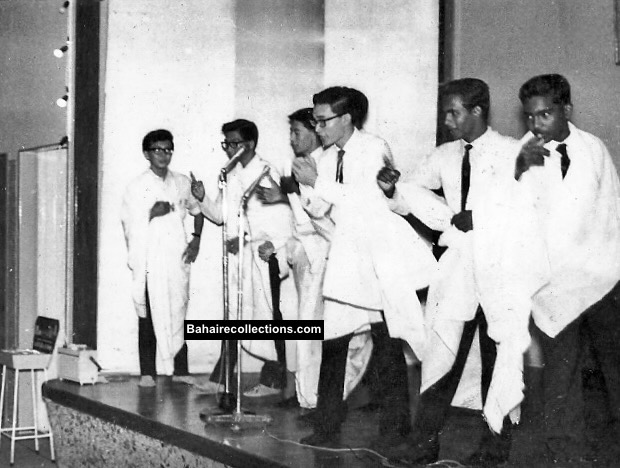
Julius Caesar Drama at Foo Chow Hall on Naw-Rúz Day 1966. R-L: Kantha Kumar, Ganesan and Yin Hong Shuen.
Ganesan’s first national event was the second National Convention held in 1965 where he met for the first time most of the torchbearers of the Faith, coming from various background and different strata of society. He saw the entire proceedings of the convention, including constructive consultations and mature discussions on the progress of the Faith in Malaysia, never realising that he was destined to be on the august national institution when the time came in 1972. At that convention itself he made instant friends with many, a bond that lasted for life!
Next was the Summer School in August 1965. Ganesan, introduced as “Master Ganesan” made his maiden and very impressive speech at the Summer School held in Malacca Youth hostel Malacca in August 1965. The late Mr. Hushmand Fatheazam, member of the Supreme Body who made his first visit to Malaysia was present at this event. Ganesan spoke on behalf of the Malayan Bahá’í youth, and highlighted the methods, achievements and challenges of the Alor Star youth. That was the sweet beginning of numerous speeches he was destined to deliver till the end of his life at several local and international arena, in his several capacities placed upon him as he grew in the Faith.
University Days
Ganesan went to the capital city Kuala Lumpur in 1966 to study in the University Malaya. In 1967, he was awarded a Kedah state scholarship, which came as a big relief given his family’s financial situation, with his father Ramasamy, a Tamil School teacher, as the only breadwinner. He initially stayed at the P. P. Narayanan Students’ hostel where another Bahá’í youth, M. Singaraveloo, studying for medicine, joined him. It was here that they met for the first time. While at the university Ganesan once again plunged into an ocean of relentless activities. After university hours he was daily at the Petaling Jaya Bahá’í Centre or at the Kuala Lumpur Bahá’í Centre. His fellow students even warned that he would not do well in his studies if he were too involved in Bahá’í activities, but Ganesan was indifferent to their earthly advice. When he moved into Petaling Jaya in 1966 he conducted children’s classes. In 1966, Ganesan was the Secretary of the National Bahá’í Youth Council. He remained on this National Bahá’í Youth Council till 1970. In April 1967, when he was travel teaching in Sarawak and received a letter to read that he was elected to the Local Spiritual Assembly of Petaling Jaya.
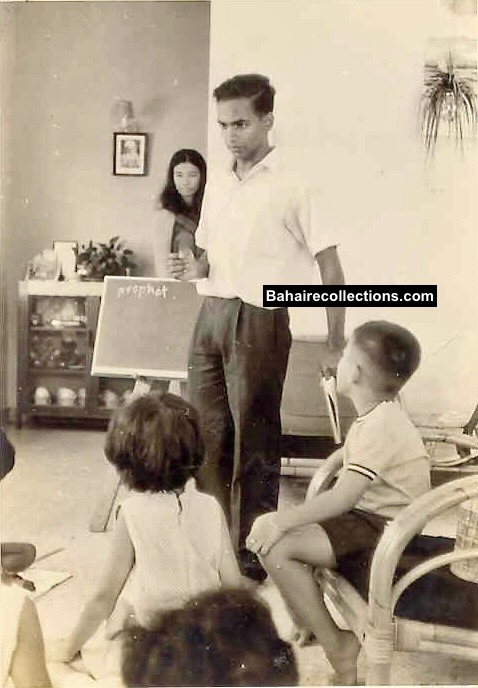
Ganesan conducing Children’s Class in 1966 at the Bahá’í Centre of Petaling Jaya, at 8, Jalan Padang.
Ganesan, along with M. Singaraveloo, and supported by fellow Bahá’í students such as R. Kanniappan and Isaac D’Cruz and a few of their friends at the University established the University Malaya Bahá’í Society and it was inaugurated on Friday, 11 October 1968. About 300 people attended the inauguration ceremony. As there were a number of Bahá’í societies in the institutions of higher learning in the country, it was felt that an Inter-College Bahá’í Societies Council would go a long way in activating and coordinating their activities. So, the Inter-College Bahá’í Societies Council was formed on 16 September 1969. This Council organized an Inter-Religious Forum on 11 December 1970 in University Malaya. Dr. M. Singaraveloo chaired it while the Bahá’í speaker was Ganesan himself.
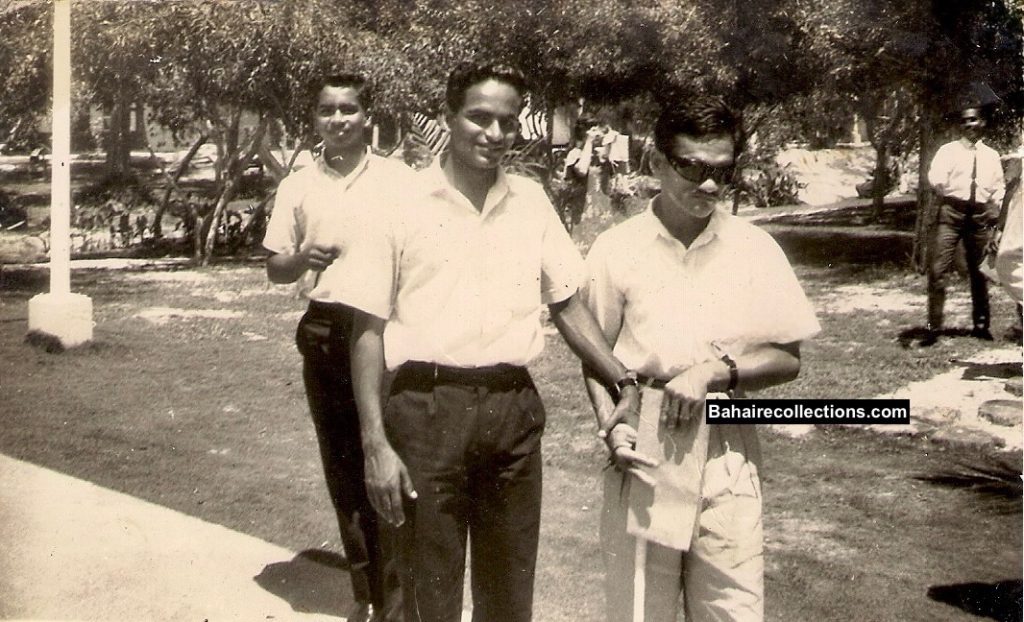
1967 Summer School at Songkhla, Thailand, L-R: Kantha Kumar, Ganesan and Luke Lee Sim Poi, the visually impaired believer.
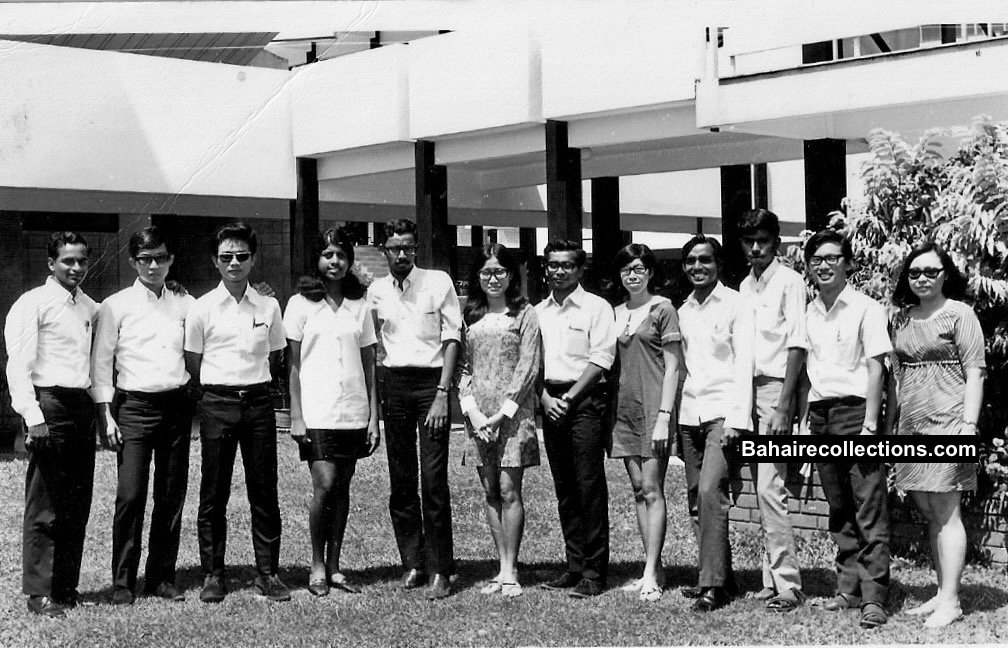
University Malaya Bahá’í Society, 1970. Standing at the extreme left is Ganesan. V. Parvathy stands fourth from left and Singaraveloo the President of the Society stands fifth from left. Miss Kung Joo Jong stands sixth from left, Kantha Kumar is seventh from left, Ramu Naidu is ninth from left and Lum Weng Chew second from right.
Every weekend Ganesan and Singaraveloo would be visiting estates and surrounding areas for teaching the Cause. At every semester break he was away on field teaching trips. In 1968, Ganesan went for a week’s travel teaching to Kuantan and concentrated on giving the message to the students at Kuantan Day Training Teachers’ College. After that Ganesan left for Sarawak to help “Penghulu” Maniam for two months. As right from the beginning Ganesan loved to provide assistance to the Tamil Speaking communities, he was also well sought as a Tamil speaker. In the later part of the 1960s, the Bahá’ís in Tanjong Rambutan town and Chemor Estate near Ipoh organized a Tamil Teaching Conference in Chemor town. Ganesan was the main speaker who talked about the Bahá’í Administration.
In 1970, he served on the Bahá’í Publishing Trust Committee. The Bahá’í Publishing Trust Committee (not the Bahá’í Publishing Trust) was established in 1968. In 1970, Francis Satkunasingam was appointed Director and assisted by Yin Hong Shuen and Ganesan. This committee was given the task of publishing suitable Bahá’í literature locally. This committee persistently endeavoured and got the “52 Bahá’í Talks” by Sidney I. Dean successfully published. Ganesan was also actively involved in giving talks at the Bahá’í Institute at Bukit Baru, Malacca, on various topics.
In July 1970, the Area Teaching Committee of Kedah/Perlis released its first issue of the newsletter called “Kedah-Perlis Bahá’í News” with the mighty effort and hard work of Chong Boo Haw. Ganesan was one of the members of the Editorial Board.
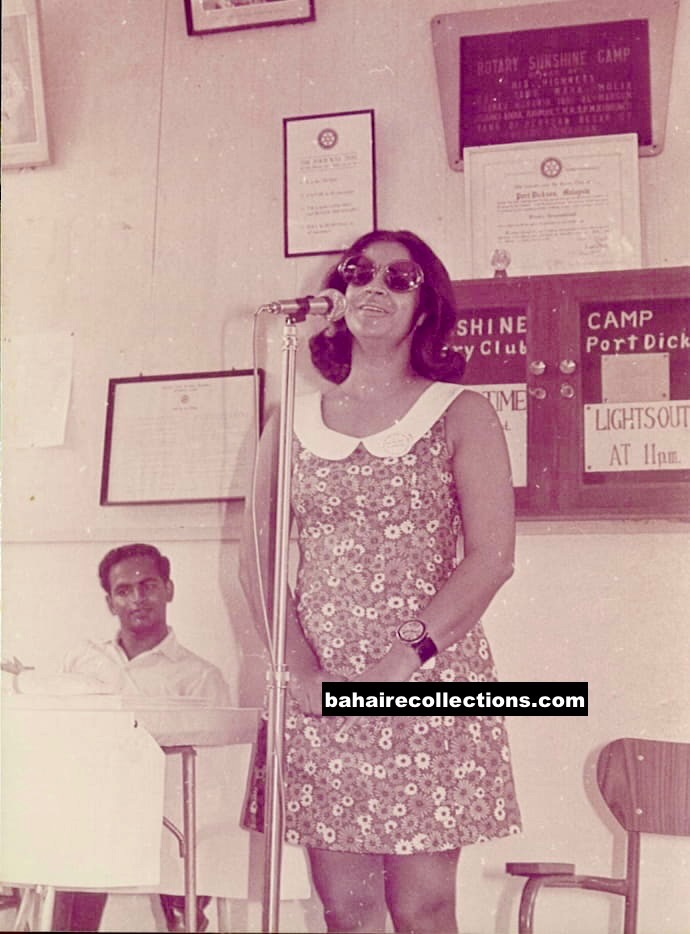
Summer School at the Sunshine Camp, Port Dickson in 1970. Betty makes her debut as newest Auxiliary Board member speaking on “The New Race of Men” with Ganesan chairing the session.
Close to the final examination for the Diploma in Education that Ganesan was supposed to prepare himself for, he was concentrating on the success of the Oceanic Conference of the South China Seas to be held in Singapore from 1-3 January 1971. As the conference opened, he as a member of the organizing committee was paying full concentration together with Leong Ho Chiew and were monitoring and reporting everything to ensure a flawless opening of the conference. That was the last activity during his university days in Kuala Lumpur.
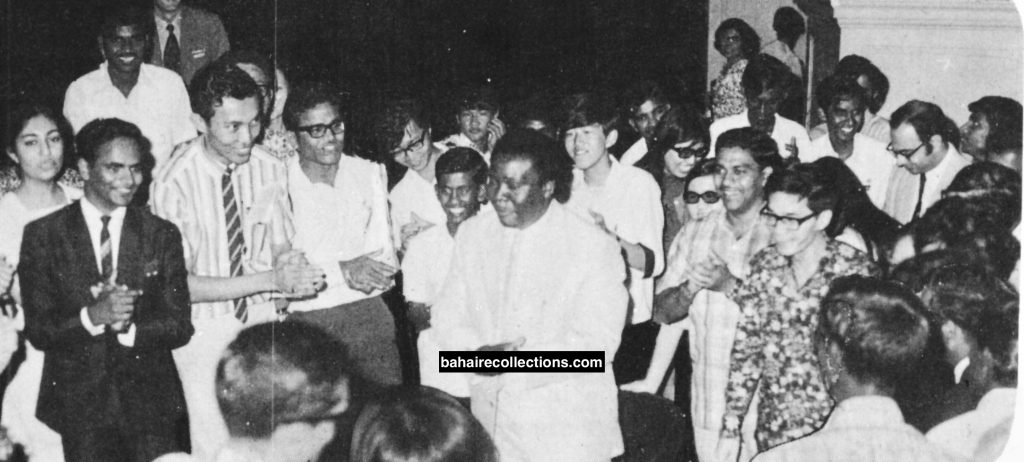
Oceanic Conference the south China seas held in Singapore in 1971. Ganesan, Choo Yeok Boon at the left. Yin Hong Shuen is wearing a Batik shirt at the right, with Hand of the Cause Enoch Olinga in the centre.
Back to Alor Star
In the early days his father Mr. Ramasamy made a hue and cry because the older siblings were fully involved in Bahá’í activities. His father was not against the Faith, as he observed the good changes slowly manifesting in his children. He was unhappy as they were not to be seen around when the father was at home and the children returned very late at night from Bahá’í activities. In later years Mr. Ramasamy did develop a deeper respect for the Faith and came to its defence whenever the Faith was attacked by leaders of the Indian community and his colleagues at school. He himself became a changed person seeing the transformation in his children. There was an incident that Ganesan used to share with friends. When his father was admitted into a hospital in Penang, in January 1971 Ganesan visited him but could not stay with him in the hospital. Around midnight he went to a friend’s home and asked permission to pass the night there. To his surprise, the friend did not allow Ganesan to stay the night at his home. Ganesan was puzzled and returned to the hospital. Just then his father already on the verge of passing on, told Ganesan to go ahead living the Bahá’í way of life and advised him not to allow anyone attack the Faith. Ganesan was in tears as he understood that as his father had already recognised Bahá’u’lláh. Only then he saw the wisdom of his friend rejecting his request to stay at his home. He recalled what the beloved Master had told us, “In everything that happens there is a wisdom and nothing happens without a reason.” That statement also became a guiding torch in his life. Ganesan’s love for his parents was boundless.
Returned with a New Dynamism
Ganesan’s return to Alor Star after his graduation opened a new chapter in his Bahá’í service. Ganesan majored in History in 1969 at the University Malaya, and did his Diploma in Education in 1970. Since he was a recipient of the Kedah state scholarship, in 1971 he started his first career as a teacher in the Sekolah Menengah Pendang, in Kedah. With he being the first graduate, the family was able to breathe some kind of comfort for the first time. But his father suddenly passed away due to chronic stomach ulcer on 16 January 1971, just 16 days after Ganesan started his career. A close friend came forward to pay for the funeral expenses, but the mother said it should be remembered as the family giving the burial. With that wise advice Ganesan had to take an advance on his first salary to pay for the funeral expenses. While alive the father had requested Ganesan to look after his siblings and mother in the event he passed away. And Ganesan took on the responsibilities to look after his siblings, all of whom were still schooling. The youngest was only four years old at the time. It was after the passing of his father that his mother Madam Kanthamany embraced the Faith. Thus, the responsibility of caring for his widowed mother and ten siblings fell upon his shoulders. Two years later his younger brother Kantha Kumar too graduated from University Malaya and started to work as a teacher in Bandar Baru, and with his support Ganesan was quite relieved.
Ganesan returned to Alor Star in 1971 and was in full swing as there were only two more years to accomplish the remaining goals of the first Nine Year Plan of the Supreme Body (1964-1973). He wasted no time in winning victories for the Supreme Body in the Malaysian soil. Ganesan bought a white colour Volkswagen in 1971 with number plate R 2244 which took him across all parts of Peninsula Malaya. He and Nagaratnam who too had a Volkswagen car teamed up together and went around the entire state of Kedah and beyond for teaching and consolidation activities. Ganesan drove all the way from his home in Alor Star to Sungei Petani to conduct deepening classes for a new set of vibrant youth there. He also visited several estates in Kedah for teaching and deepening the believers, using the slide show projector which he had purchased. The car also was helpful in penetrating into areas hitherto untouched. In many of his teaching trips that this car went Ganesan took along his family members and other believers. In 1971, Ganesan with his cousin Jayabalan opened Langkawi Island to the Faith. In 1972 he was elected to the Local Assembly of Alor Star and was also on the Malaysia -Thailand Border Committee.
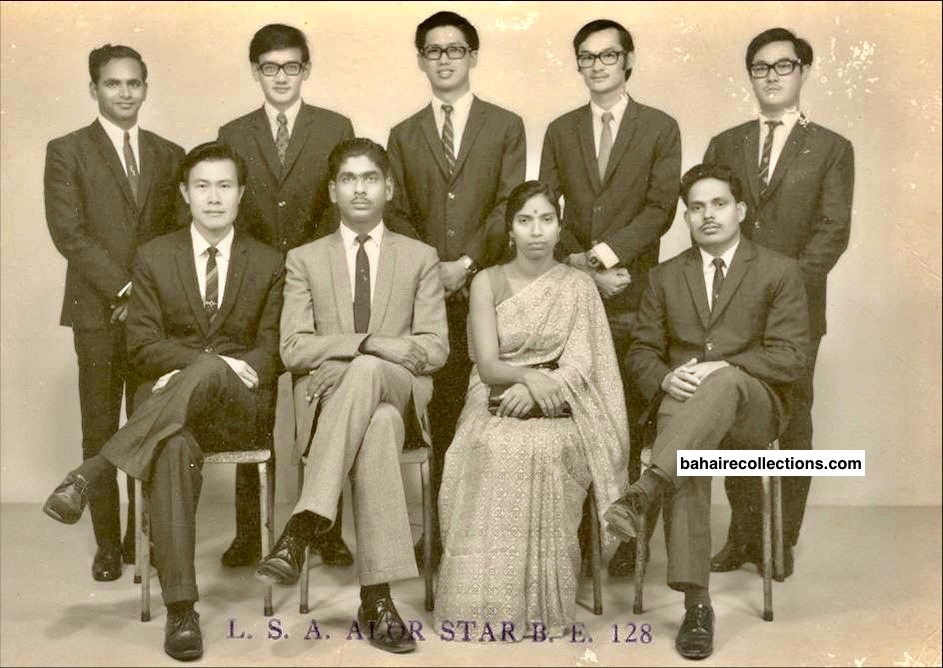
LSA of Alor Star for 1972. Standing L-R: Ganesan, Tan Boon Tin, Chong Boo Haw, Teh Teik Hoe, Teh Teik Chow. Seated L-R: Mei Siew Hong, Nagaratnam, Sarveswary, M. Subramaniam.
His family’s moved into the Alor Star Bahá’í Centre
When Ganesan graduated his family was living in a modest Malay style home in Jalan Stadium in Alor Star very close to the Bahá’í Centre at 7, Jalan Serai. As the top floor of the Bahá’í Centre was vacant, with the permission of the Local Spiritual Assembly, he moved with his family to reside at the top floor of the Bahá’í Centre. That was the beginning of the entire family being involved and immersed in Bahá’í activities, almost round the clock, with visitors turning up even at the wee hours of the night.

First Nine-Day Spiritualization Institute in Port Dickson. Sitting L-R: Lily Ng, Rajambaal Nagaratnam, Theresa Chee, Yankee Leong, Dawood, Jenabe Caldwell, Shantha Sundram, Betty and Lily Chinniah. Standing L-R: Ganesan, Navanita Sundram, Koh Ai Leen, G. Appala Naidu, Nagaratnam, Dr. M. M. Sreenivasan, Mathews Wagner, N. Nagendran, Kenneth Mak, Dr. M. Singaravelu, M. Ganesan and Ramu Naidu.
In 1972, National Spiritual Assembly appointed Ganesan to serve on the National Child Education Committee. It was in this year that he was elected to the National Spiritual Assembly of Malaysia at a young age of 25. In 1974, he was Assistant Secretary. In 1976, he served as Secretary of the National Spiritual Assembly. As Secretary he had to send out communications to the community, especially Feast Newsletters. Ganesan used to prepare the Feast letters in English while his brother Jayagopan, only 12 years old then would translate ably into Malay with the assistance of his other siblings, and Mei Siew Hoong would translate that into the Chinese language and write it out on a stencil, while V. S. Maniam would translate and write into the Tamil language on a stencil. All these will be cyclostyled in the Alor Star Bahá’í Centre. All the members of the family, including the mother would prepare the envelopes by inserting the newsletters into the envelopes, pasting the addresses of the 500 Local Spiritual Assemblies, sticking the stamps, inserting all those envelopes into a large bag and take them to the post office, around 2:00 am. Thus, the entire family served as a secretariat. This whole process was repeated every Bahá’í month!
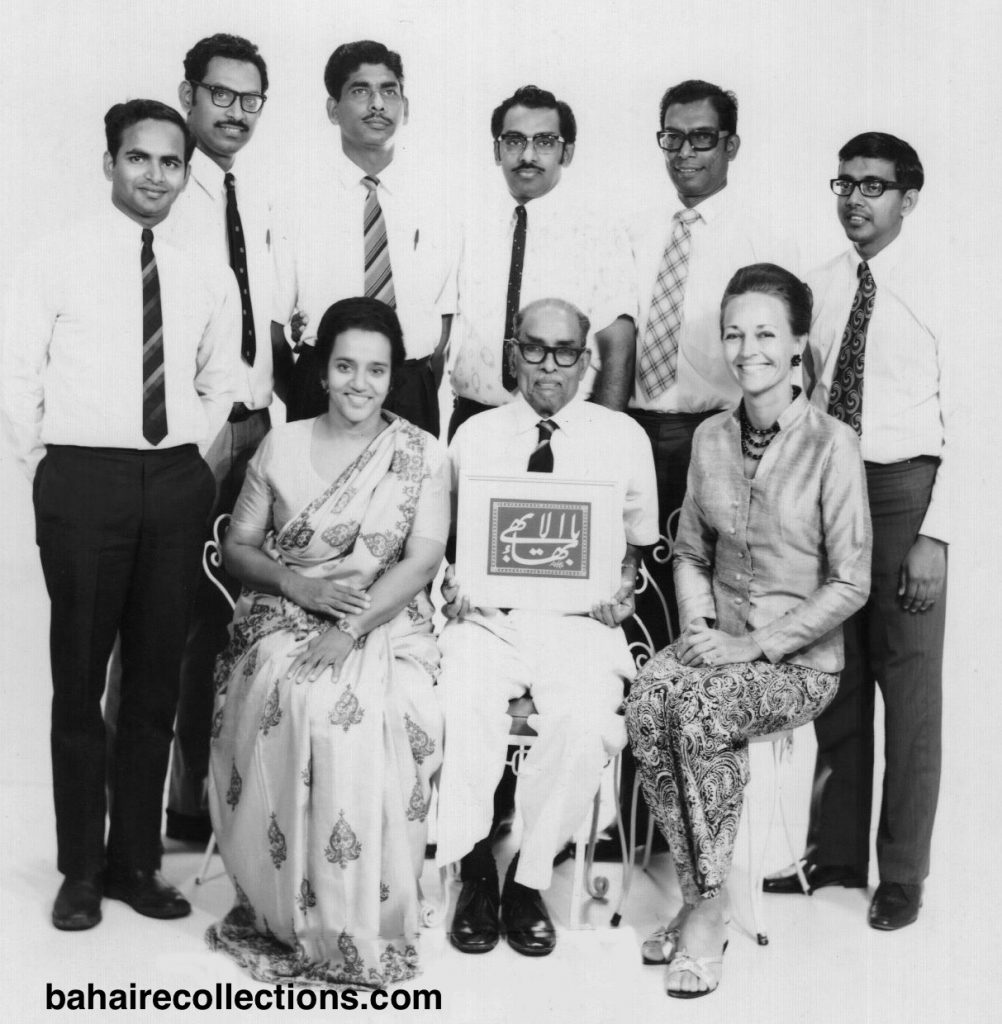
NSA of 1972. Standing L-R: Ganesan, S. Baskaran Nair, S. Nagaratnam, Dr. M. M. Sreenivasan, Inbum Chinniah, N. S. S. Silan. Seated L-R: Mrs. Shantha Sundram, K. Rajah, Mrs. Elizabeth Gibson.
Ganesan at this time was also serving on the Continental Pioneering Committee along with Yin Hong Shuen and Nagaratnam in 1974. This Continental Pioneering Committee kept in touch with the pioneers abroad through constant communication. It also looked into the pioneering needs in many goal areas. In 1976 there existed the Malay Translation Unit and Ganesan and Phung Woon Khing were among those who served on the committee. Ganesan married Miss Panjawarnam, a court interpreter in Alor Star on 13 April 1975. This marriage produced three wonderful children – two girls Shantini and Sheila, and a boy Rajmilan. His wife Panja, though a relatively new Bahá’í at time of her marriage to Ganesan, became a strong buttress and support for Ganesan’s dedication and service to the Faith.
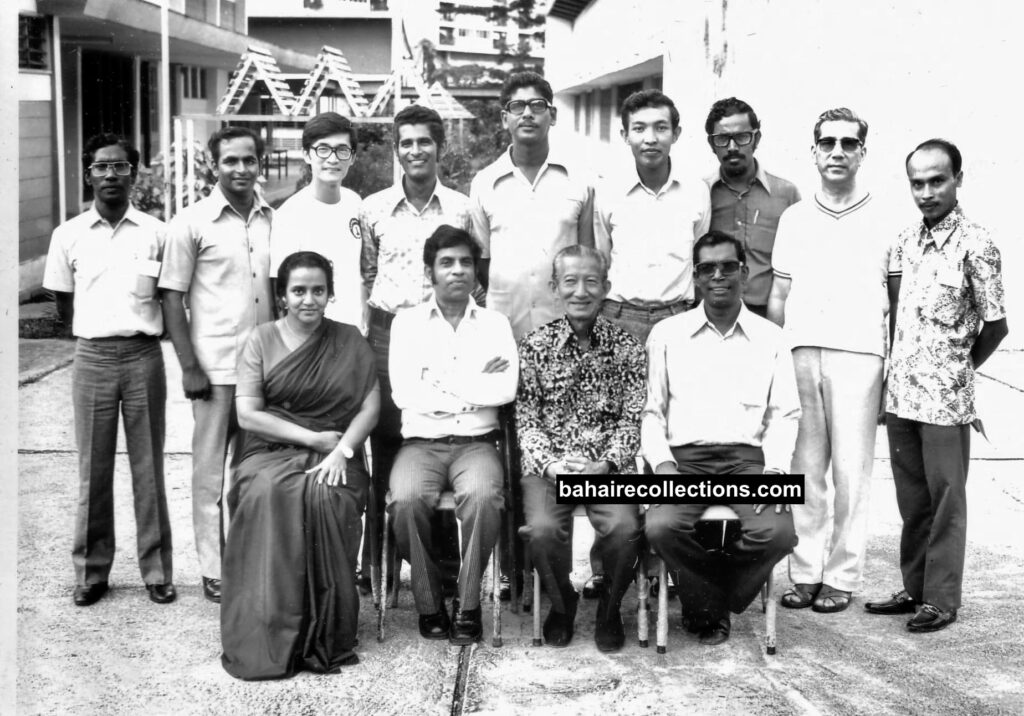
Winter School in Johor Baru, December 1974. Standing are members of the National Spiritual Assembly L-R: Maniam, Ganesan, Yin Hong Shuen, Isaac D’Cruz, S. Nagaratnam, Captain Choo Yeok Boon, Dr. Singaraveloo, Dr. John Fozdar, and Ragai Lang. Seated L-R: Auxiliary Board member Shantha Sundram, Counselor Dr. Chellie John Sundram, Counselor Yankee Leong, and Auxiliary Board member Inbum Chinniah.
While residing in Alor Star at the time, Ganesan recognized the necessity of relocating to Kuala Lumpur to fulfill his responsibilities more effectively as Secretary of the National Spiritual Assembly, thereby dedicating himself more fully to the service of the Faith. He used to go for the meetings of the National Spiritual Assembly with S. Nagaratnam over the weekends and as soon as the meeting was over on a Saturday evening, they would drive immediately back to Alor Star, a journey covering eight hours on a winding and dangerous road. Both would arrive almost at dawn and after two hours of rest, they would report for duty in their respective schools. This was taking a toll on his health. Added to that, when he became Secretary of the National Institution, he had to work at home all alone, in the absence of the secretariat which was at the National Bahá’í Centre in Kuala Lumpur. There was only some extent that the members of the family could assist as he had to deal with many confidential matters, including preparing of reports and minutes and communications to individuals and institutions, both local and abroad. He found it most necessary to move to Kuala Lumpur to be more effective. Finally in 1976 Ganesan got a transfer to Kajang High School in the state of Selangor. He then moved into a modest house in Kampong Pandan area in Kuala Lumpur. His other siblings also started to move out in stages. The last to move out from the Alor Star Bahá’í Centre at 7, Jalan Serai was his brother Kantha Kumar and wife Odette, one month after their eldest son was born in 1979. The family had stayed in that Bahá’í Centre for 9 years.
To Tanzania for the Love of Dr. Rahmatu’lláh Muhájir
Ganesan first met Dr. Muhájir when he visited Alor Star in 1966. In 1977, Dr. Muhájir requested the National Spiritual Assembly of Malaysia to select a few believers to undertake teaching trip to Africa for six months, and one of them identified was Ganesan who was on the national institution. As Ganesan was preparing to move to Tanzania for a period of six months for travel teaching in early May 1977, his wife Panja appealed to Dr. Muhájir to spare her husband from leaving the country at that time as she was about to give birth to her second child. Dr. Muhájir lovingly replied to her, “I myself have not seen my daughter Gisu for three years!” On 12 May 1977, Ganesan set off to Tanzania. Just before that Dr. Muhájir gave a letter to Ganesan to go to the House of the Báb on his way to Tanzania. In Shiraz, the Iranian Bahá’ís saw Ganesan was very emotional as he entered into the House of the Báb. By Ganesan’s own accounts, that was the most memorable incident in his life. Ganesan prayed in the House of the Báb. On May 29 the day of the Ascension of Bahá’u’lláh, Ganesan went to the blessed House of Bahá’u’lláh in Teheran. He prayed in the very room in that House where ‘Abdu’l-Bahá was born. It was on the following day 30 May, his wife gave birth to a baby boy whom she named Rajmilan. His son’s birth was not known to Ganesan until one month after he arrived in Tanzania when he received a letter from his wife. Upon his return from Tanzania, the family moved to Petaling Jaya, at SS 4/9, Petaling Jaya up to 1980.
Auxiliary Board member and Member of the National Institution
At the Regional Bahá’í Conference held in Singapore in December 1977 Counsellor Inbum Chinniah announced the appointment of Ganesan as an Auxiliary Board member, serving under him. But when Hand of the Cause of God Dr. Muhájir made his last visit to Malaysia in 1979, it was Ganesan who drove him to the Subang International Airport to send him off. On the way to the airport, Dr. Muhájir informed Ganesan that he had requested Inbum to relieve him as Board member, which was accordingly done. In 1980 he was elected to National Spiritual Assembly and served as Secretary and remained in that capacity till 1982. As Ganesan had health issues and on the advice of Counsellor Yankee Leong he resigned from the national institution and was once again appointed a Board member in July 1983. Ganesan went to the UK for further studies in September 1984. Upon return he was back as an Auxiliary Board member, serving under Counsellor Shantha Sundram. He served in the National Spiritual Assembly again from 1993 to 2003. During this period, he was one of the early members of the Institute for Development which launched and promoted the institute process in the country and laid the foundation for the advancements in community building. Ganesan had served in various capacities, including Member of the National Spiritual Assembly for three terms and as Auxiliary Board member for two terms.
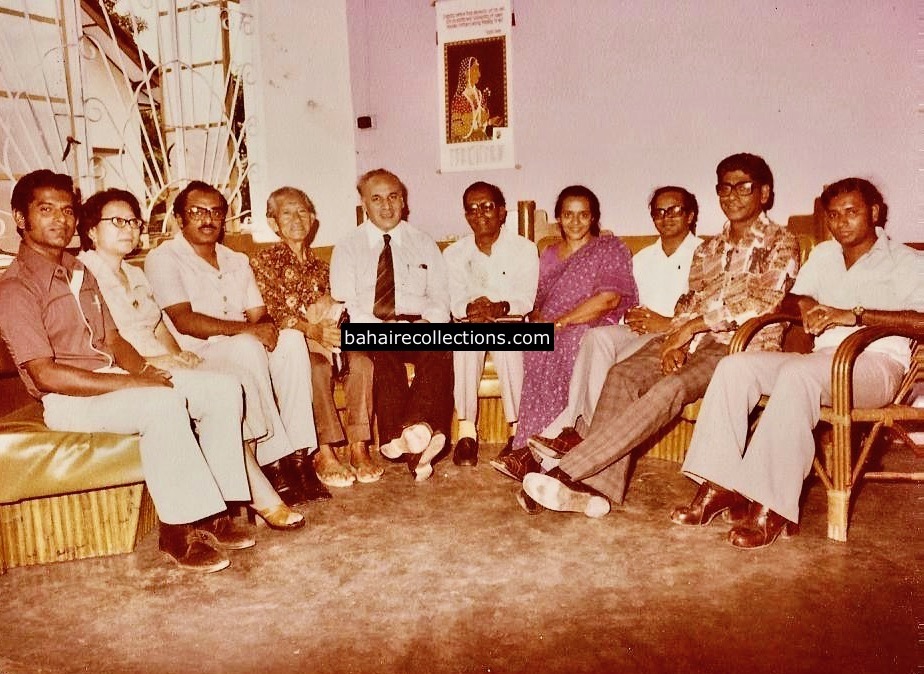
Meeting of members of the Spiritual Assembly of the Bahá’ís of Malaysia and Auxiliary Board members with Hand of the Cause of God Dr. Muhájir at the National Bahá’í Centre, Kuala Lumpur, 1978. L-R: NSA member Isaac D’Cruz, Board member Mrs. Theresa Chee, Board member Dr. Sreenivasan, Counselor Yankee Leong, Dr. Muhájir, Counselor Inbum Chinniah, Board member Mrs. Shantha Sundram, Board member Ganesan, NSA member S. Nagaratnam, NSA member S.Balasekaran.
Serving on the National Spiritual Assembly, especially as Secretary and on the Auxiliary Board, Ganesan had the rare privilege of moving widely with the individuals and institutions in the country. He had the pulse of the community. He was seen as an able Secretary of the National Institution, who was well organized. All his reports, including annual reports received accolades from the delegates and members of the community. He had an uncanny ability to present the reports with minute details and with good analysis. Hands of the Cause, especially Dr. Muhájir and Mr. Collis Featherstone who were briefed by Ganesan during their visits were highly impressed with him. During his tenure of secretary, he worked daily from after school, with a short break for lunch, right up to past midnight. He recruited many able and trustworthy believers to assist as volunteer at the National Bahá’í Centre. The letters he wrote to the other institutions and individuals too were coated with much spirit that the readers were simply moved.
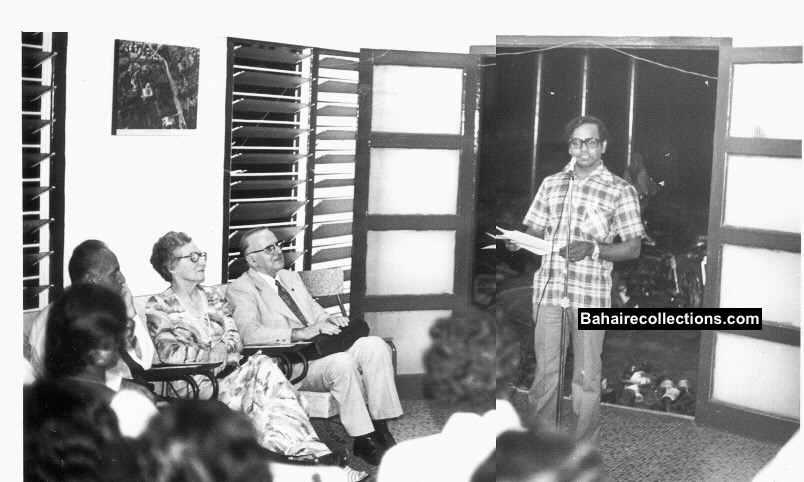
Ganesan, Secretary of the NSA of Malaysia presenting the growth and development of the Faith for the community in Petaling Jaya in 1977. Seated at the left are L-R: Hand of the Cause Dr. Muhájir, Mrs. Madge Featherstone and Hand of the Cause Collis Featherstone.
Other Prominent Activities
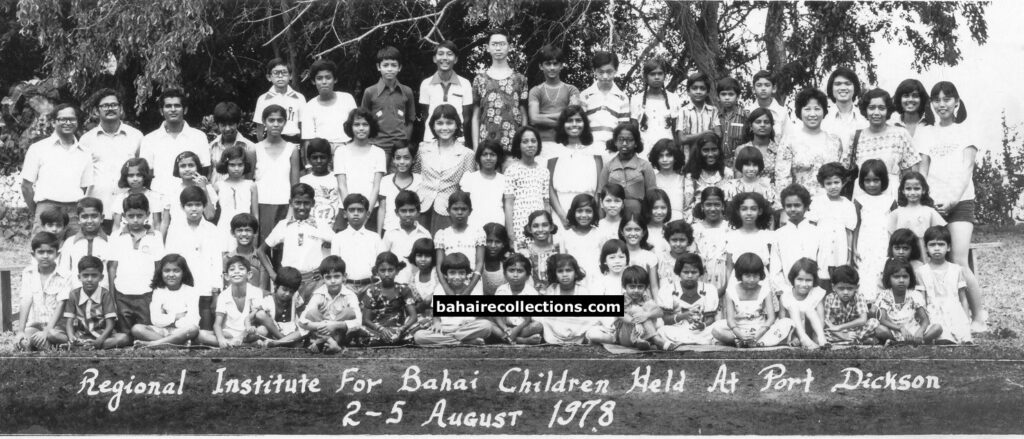
Ganesan was involved in a wide range of activities, which cannot be mentioned here owing to space constraint. When the first Regional Children’s Institute and Regional Conference was held at Stella Maris Bungalow at Port Dickson from 2-5 August 1978 Ganesan was one of the coordinators. When the Pre-Declaration Institute was held from 2 to 6 December 1972 in a large bungalow in Tanjung Bungah in Penang Ganesan was one of the teachers. A very successful West Malaysia Youth Camp was organised by the National Bahá’í Youth Council on 6 and 7 April 1978 at the Malacca High School where Ganesan was one of the speakers. When the first summer school for the East Coast was held from 28 to 31 July 1978 at the Belia Complex, Kuantan, Pahang, Ganesan spoke on “Reverence and Courtesy”; “Manners and Dress” and “Artistic Pursuits”.
Standing L-R: Ganesan, Rama Naidu and Isaac DCruz.
Later in life, Ganesan also was instrumental in launching the 9-Star Study Program which became, at that time, a program for the systematic study of the Faith. As a lover of history, he had conducted classes on the Dawn Breakers for two years in Kuala Lumpur. The classes transformed the lives of the participants and inspired several of them to rise as pioneers, writing their letters of offer to the National Assembly from that class.
Tamil Speaking Community
From 1963 he had gradually developed a wide range of friends not only in the English speaking communities by also among the Tamil speaking friends. Ganesan moved very closely with the Tamil speaking community as he felt they needed much assistance in terms of deepening classes and consolidation. He never missed gatherings for the Tamil speaking friends where he would deliver excellent talks, which the listeners welcomed. Ganesan recollects of two important contributions to the Tamil speaking community in Malaysia. When he was a Board member in 1990 he requested A. Manisegaran (author of this story) being an able writer, if there was any possibility of staging a drama based on an episode from the Dawn Breakers. The latter immediately consented. Ganesan then took up the matter with the Local Spiritual Assembly of Hulu Langat to stage a drama. Then the drama based on the Seven Martyrs of Tehran was staged during a winter school in 1990, with the story adapted from the Dawn Breakers with A. Manisegaran writing the dialogue and taking care of directing. Professional stage and props were set up by the believers of Hulu Langat. Kalavathy Appuraman, a talented artist took care of preparing the props, while professional musician and another professional make-up artist were also roped in. That was the first time a professional drama was staged in the history of the Faith in Malaysia. The drama was able to bring to life the very episode from the Dawn Breakers. The beheading of heads and splashing of the blood from their heads were so real. Ganesan saw the extent to which the entire community of Hulu Langat worked as one soul in different bodies, as never before. A copy of this video was passed on to the Supreme Body for archiving. The video was screened for pilgrims at the Studio of the International Teaching Centre in the Holy Land. Moved by this drama, Ganesan wrote to Counsellor Shantha Sundram a full report of that memorable drama.
There was yet one more event that was etched in his memory. In the past several attempts were made in different parts of Malaysia, especially in Kedah where the believers produced Bahá’í songs and sang them at Bahá’í gatherings. But the past efforts were not professionally done. Mr. Govindasamy, a new Bahá’í who accepted the Faith during the Project 1000 met Ganesan and informed him of his professional singer friend, by name of M. S. Gopalan, younger brother of Tamil cinema industry playback singer Malaysia Vasudevan, who was willing to sing Bahá’í songs in Tamil with a view of getting them produced professionally in audio cassette form. Govindasamy brought Gopalan to the house of Ganesan and used the piano in the house to improvise the songs which were sung earlier by the believers. Then the professional studio of Datuk L. Krishnan was rented and the band was paid to record the Bahá’í songs in the most professional manner. Gopalan himself sang all the songs to the greatest satisfaction of the believers. One thousand cassettes were produced and launched at a Summer School of which 500 were sold on the spot. That was the first time Tamil Bahá’í songs were produced by the Local Spiritual Assembly of Hulu Langat. To Ganesan these two remained the most memorable episodes in his life.
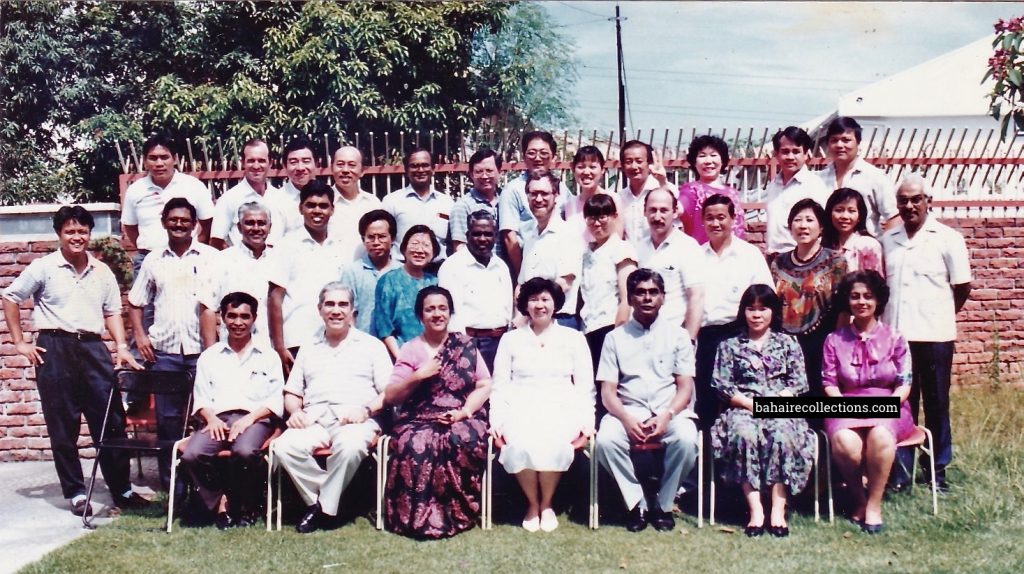
Conference of Counselors and Board members, 1991. Board member Ganesan stands fifth from left at the back row.
His Teaching Profession
In 1971, he was a teacher at the Sekolah Menengah Pendang in Alor Star. In 1976, he taught at the Kajang High School. In 1979, he moved to Maktab Perguruan Seri Kota from Kajang High School. In 1980, he was senior assistant of Maxwell Secondary School in Kuala Lumpur and was staying in government quarters at 2518, Jalan Belfield, Kuala Lumpur. At the end of 1984 he went to do Masters program in the United Kingdom and returned to Kuala Lumpur in December, 1985, six months earlier due to his ill-health as he was suffering from rheumatoid arthropathy and could not bear the winter season in England. This time he was a was Senior Assistant of Sekolah Menengah Datuk Lokman in Kuala Lumpur. In 1992, he was heading the “notorious” Sekolah Menengah San Peng, a school of 2,000 students with a reputation for gangsterism. It was a big challenge, yet he was able to manage the school well. In 1993 the Malaysian Ministry of Education sent Ganesan with a cohort of senior education officers on a short term educational course to Stanford University. In 1996, he was made Head of Maktab Perguruan Teruntum (a Teachers’ Training Institution) in Kuantan, Pahang until 1999, when the Teachers’ Training Division of the Ministry of Education Malaysia made a decision to close down smaller colleges, and Seri Kota was one of those affected. He was then asked to oversee the closing down of Seri Kota. He returned to Kuala Lumpur in 1999, where Ganesan helped set up the International Languages Teacher Training Institute (IPGKBA) at Lembah Pantai and served as its principal. The family stayed in the quarters of this institute until his retirement in August 2003. Ganesan served in the teaching profession in the Bahá’í spirit of “Work is Worship, Service is Prayer”, so much so that he left an indelible trace of good record in all the places he served. And whenever he had to leave one school to another there was always a tearful farewell for him as he always won the love and respect and admiration of the students and teachers. They all knew him as a wonderful Bahá’í.
The Kuantan Days
His time in Kuantan community from 1996 to 1999 needs special mention. There was a new dynamism in the community during his presence there. He used to hold many firesides in his home and used to gather the children and youths to guide them in the Faith. He served as the Chairman of the Local Spiritual Assembly until he left the community in 1999. With Ganesan’s efforts several new activities were initiated. He invited Counsellor Shantha Sundram to his residence to meet and guide the youth. He brought Nagaratnam to conduct sessions on the importance of prayers and meditation. While actively involved in the local activities, Ganesan was also away to other communities for activities organised there. As Ganesan was elected to the national institution for the third time during his residency in Kuantan he was away to the meetings of the national institution during most of the weekends. One of the well-remembered undertakings which he led was the raising of funds to build the community’s own Bahá’í Centre in Kuantan. He invited Dr. John Fozdar from Sarawak to perform the opening ceremony of new Kuantan Bahá’í Centre in October 1997. It was a grand affair with performance of lion dance as well and remains one of the milestones in the history of the Faith in Kuantan. His stay in Kuantan left indelible traces, as was the case in whichever community he resided.
His Home was a Sanctuary for all
Ganesan always had given priority to opening his homes for Bahá’í activities. His house, wherever he resided was open to anyone round the clock from Alor Star days right up to his last days in Subang Jaya. When purchasing groceries, he had to do it for his family as well as the frequently visiting Bahá’ís. There was no visitor who had left his house without partaking of meals. His mother Madam Kanthamany and wife Panja were fully supportive of providing the best hospitality for visitors. There was always space in his house for visitors who had stayed for weeks or even months.
Opening of the homes for everyone was a culture that was started by his father Mr. Ramasamy. During Ganesan’s youthful years Mr. Ramasamy would without fail slaughter a goat and cook personally for the whole family especially on Deepavali festival. Many of the youthful Bahá’í friends of Ganesan and Kantha, and especially Luke Lee will come and join the family’s celebration. All would be treated with banana leaf dinner that Mr. Ramasamy would personally serve. This was a gesture supported by Ganesan’s mother a tradition that she continued after the passing of her husband with Ganesan following suit.
When Ganesan moved into the Bahá’í Centre at 7, Jalan Serai in 1971, it became the house of the entire community. And this was the time when the family events became community affairs as well, with the family blending so well with the community. Visitors would walk in any time and they were sure food would always be available. Thanks to the generosity of Madam Kanthamany who would always cook extra for those visitors. When large scale community events were organised, she would cook all the three meals and prepare tea for whoever stayed overnight – whatever the numbers.
Ganesan came to stay in Kampong Pandan in Kuala Lumpur in 1976 after his marriage, and though a modest home, his hospitality did not diminish, with his wife Panja coming forward to carry on the family tradition of hospitality. The stay in Kampong Pandan was only for a year, and yet the hospitality saw no bounds.
Upon his return from Tanzania in 1978 they stayed at SS4/9, Petaling Jaya, up to 1980. Several believers and members of the institution from various parts of the country kept visiting Ganesan for discussing matters related to the Faith. While teaching at the Maxwell Secondary School in Kuala Lumpur in 1981 he was staying in a spacious government bungalow at 2518, Jalan Belfield, Kuala Lumpur for some ten years. That house became a centre of Bahá’í activities where deepening classes or mini conferences were held. Believers used to wonder if this was a residence or a Bahá’í Centre as this was truly a centre of activities. Several outstation believers and visitors stayed in a special room on the ground floor. During weekend classes the participants slept in the living room.
After Retirement
In 2003, the year when he was still on the National Spiritual Assembly he resigned to pioneer. That was the year he moved to their own house in Subang Jaya and serving the Cause there. In 2004 he and his wife went travel teaching to Fiji Islands where his eldest daughter Shantini was serving as a pioneer. In in August 2004 Ganesan was called upon to head the New Era High School at Panchgani, in Maharashtra, India. It was during his tenure as the Principal there that the sixtieth anniversary celebrations of the school was organised in a very befitting manner. As Principal of New Era High school, Ganesan invited Mrs. Shantha Sundram to the school to hold a three-day training session for the Bahá’í children on the subject of prayer. The three-day sessions went very well, and the children were thoroughly absorbed in the sessions which Shantha conducted, supported by her daughter Susheel with music and activities. Ganesan later received feedback from those children on how it transformed their lives and made them always turn to prayer. Ganesan returned to Malaysia when the academic year ended in April 2006.
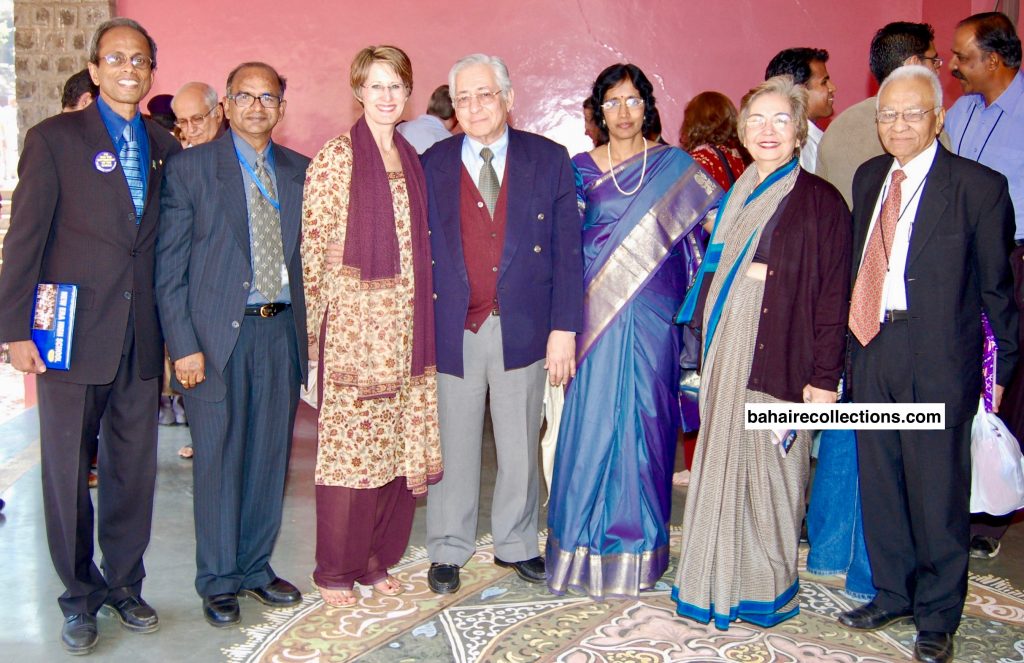
Sixtieth Anniversary celebrations at the New Era High School, Panchgani, Pune, India. L-R: Yogachandra, Ganasa Murthi Ramasamy, Debbie, Soli Sorabjee (former Attorney General of India), Panjawarnam Ganasa Murthi, Zena Sorabjee, R.N. Shah.
Apart from his several trips to Sabah, Sarawak and Singapore, he also went to several other countries for service. Briefly, he went to Burma, Thailand, Laos and Cambodia. His trip to Cambodia was to prepare the community for the election of the first National Institution in 1994. Earlier in 1986 he went to Guyana to visit the family of his pioneer sister Kalavathy and visited many schools in the coast and gave talks on the Faith.
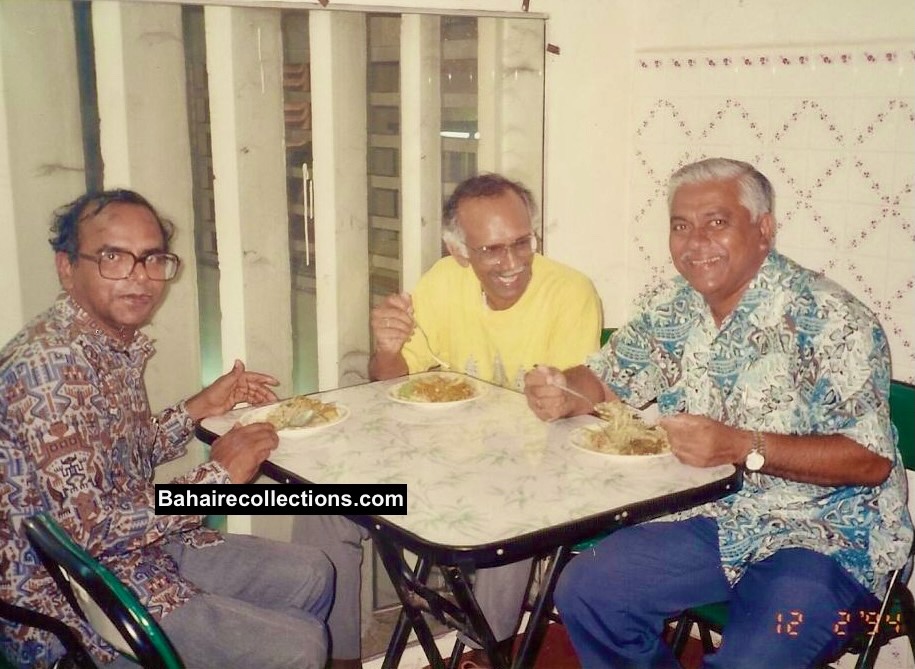
April 1994 at the home of S. Satanam in Kampong Som (Sihanoukville) in Cambodia L-R: Ganesan, S. Ravichandran and S. Satanam.
God-Intoxicated Servant
Ganesan had shaped his Bahá’í life by reading and following the Writings, by association with luminaries from the early days such as the several Hands of the Cause whom he met in Malaysia and abroad, starting with Dr. Muhájir’s first visit to Alor Star in 1966. Ganesan had the rare privilege which many did not have. At the end of April 1976, when Ganesan was Secretary of the National Institution, Dr. Muhájir visited Malaysia and invited him to his room in Hotel Merlin. Dr. Muhájir sat on a chair to say his prayers. After a number of prayers, he started chanting the Tablet of Ahmad in Arabic. Ganesan would often recall that as the most melodious chanting that he had ever heard. Ganesan moved very closely with Dr. Muhájir as he attained his presence in almost all his visits to Malaysia and given the responsibility he held as Secretary of the National Institution presenting reports and briefing him on the progress of the Cause in Malaysia. Among the other Hands he met in person were Mr. Collis Featherstone in Malaysia, Mr. Abu’l-Qásim Faizí, Mr. William Sears, Amatu’l-Bahá Rúhíyyih Khánum, Dr. ‘Alí-Muhammad Varqá, ‘Alí-Akbar Furútan and several others while traveling abroad. These “Diffusers of Divine Fragrances” had great spiritual impact on him. Locally he always moved with several star servants of the Cause from 1963, far too many to mention. Among them were Mrs. Theresa Chee, Mr. S. Nagaratnam, Mr. Yankee Leong, Mr. Leong Tat Chee, Mr. Inbum Chinniah, Dr. John Fozdar, Mr. Appu Raman, Mr. S. Satanam, Mrs. Shantha Sundram, and Dr. Chellie Sundram.
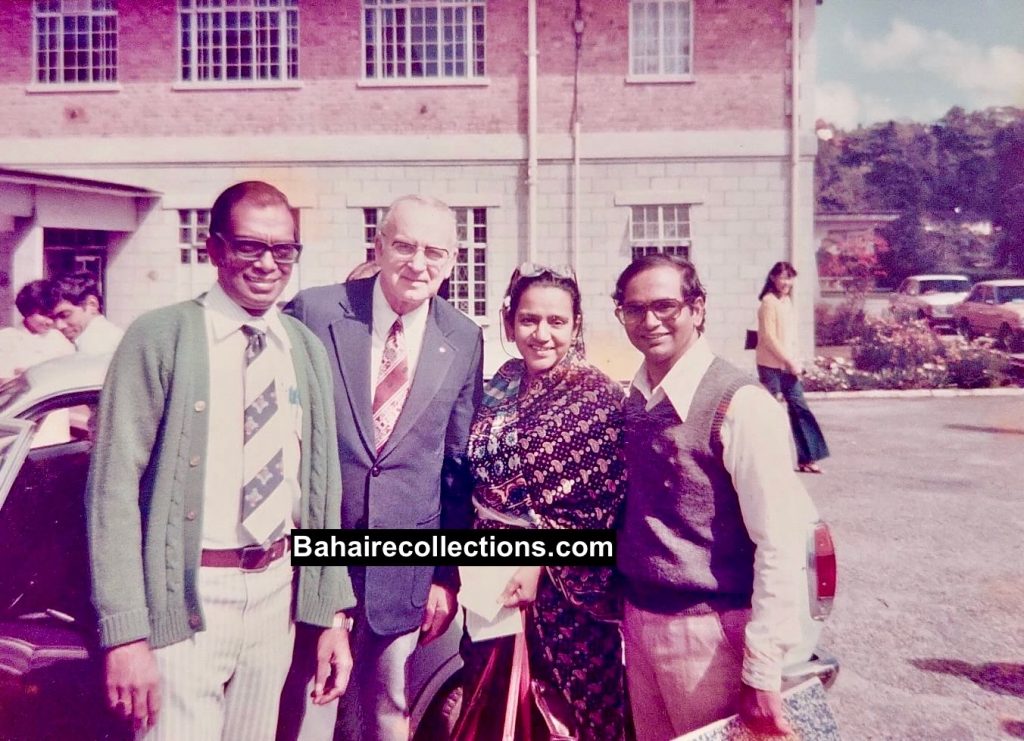
Winter School of December 1979 at the Cameron Highlands. L-R- Counsellor Inbum Chinniah, Hand of the Cause Collis Featherstone, Board member Mrs. Shantha Sundram and Ganesan.
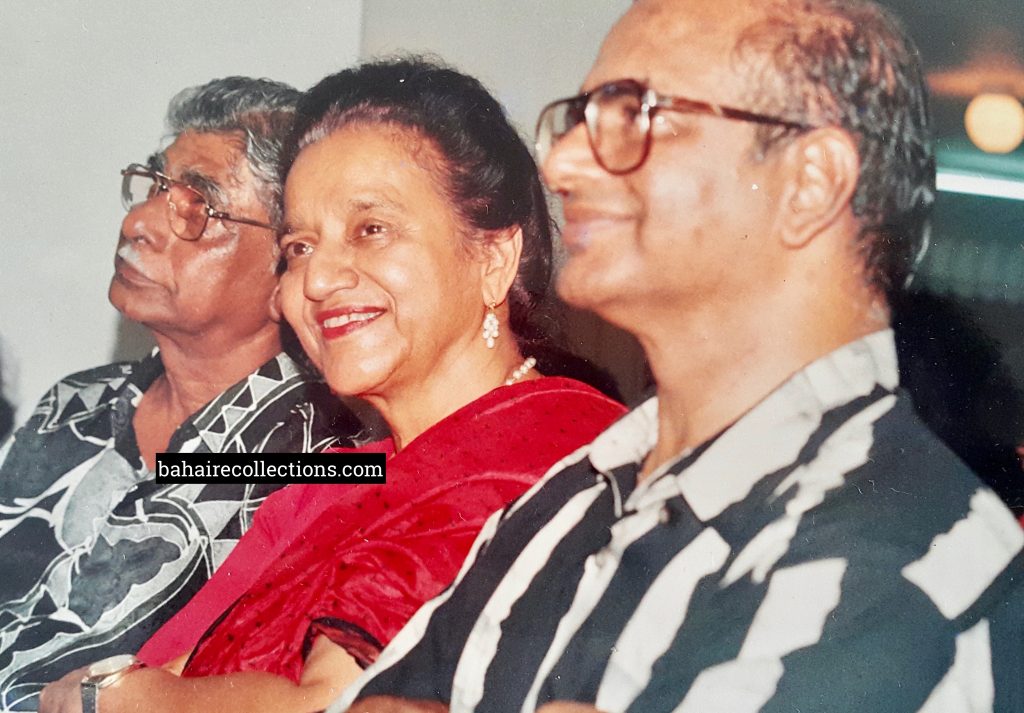
Among those Ganesan loved and highly respected. L-R: S. Nagaratnam, Shantha Sundram and Ganesan.
Man of Fine Virtues
Apart from ardent service for the Cause, Ganesan was also known as a person of great virtues. He was endowed with some fine virtues, quite unique to him alone. It was these virtues that attracted many to him. From the time he accepted the Faith in 1963, he always served the Cause without seeking any popularity or prominence. He used to say to very close friends, “Whenever any task was given to me I carried out those tasks with utter sincerity.” Truly, sincerity in serving the Cause has led Ganesan to stellar performance. Apart from that whenever he detected any believer having any talents, he gave every encouragement for the believer to excel in his area of expertise in the interest of the Faith. When someone was undertaking any task for the Faith, he would give the strongest support. Although Ganesan was talented and had a strong driving force, he never believed in dominating the affairs of the Cause. He remembered well the advice by Hand of the Cause of God Dr. Muhájir, “Among the believers there has to be spiritual generosity, that is sharing out with other believers whatever task you are undertaking as the more the participation, the better the results.” Of criticisms, he would say, “One has to be interested in the opinion of Bahá’u’lláh alone and move on unrestrained as the wind.” Whenever he was hurt while serving, he would say, “Ultimately, truth will outride fiction!” He did not believe in responding to those criticism, rather he preferred to suffer in silence and rely heavily and fully on the power of divine assistance.
It need not be mentioned that Ganesan was a very humble believer who did not believe in placing himself above others. He possessed true reverence and spirit of humility equalled by few. Whenever anyone sought any advice, he gave advice from the Writings. From the early days of the acceptance of the Faith Ganesan was an avid reader and collector of all the Bahá’í magazines and books he could get hold of both from within Malaysia and abroad. Over the period of time, he had one of the biggest collections of Bahá’í books in his possession. Believers flocked to him to have the right answers for questions on the Faith. He was in many ways a “walking dictionary”. That may also explain why Ganesan was always a natural choice as speaker at Bahá’í gathering. As a speaker he had a rare ability to instill much spirit into the hearts of the listeners. He always had some great information coated with spirit. He was in that sense one whose talks the participants never wanted to miss.
Love and Respect for elders
Ganesan’s love and respect of elders in the Faith was simply boundless. He not only respected institutions or members of the institutions, but several other individuals who had risen to serve the Cause. And in order to keep them in his memory, he collected something from them. He used to say that his life was very much influenced by the examples set by Mr. Yankee Leong and Mrs. Shantha Sundram. He kept the teaching aids prepared by Yankee Leong and his paintings as well. On the occasion of the Fiftieth Anniversary of the acceptance of the Faith by Yankee Leong, held in Ipoh town in 2003, Ganesan produced a documentary file on Yankee Leong, which was screened at the venue. Ganesan received most of the Bahá’í photographs that Shantha Sundram published in the Malaysian Bahá’í News, of which she was the chief editor, at a time she left the country for Australia. Ganesan also had the Bahá’í ring of Leong Tat Chee which he gave to him before the former’s passing in 1972. Ganesan also had some paintings by Dr. Chellie Sundram. When Dr. Chellie Sundram passed away Ganesan was asked to say some words, and he was sobbing away having lost one of the most dynamic, talented and highly resourceful believers who had given all the encouragement to Ganesan to rise higher in life and service. The one person who permeated his soul was Counsellor Inbum Chinniah, after whose passing on 5 February 1980, Ganesan ceased to be a normal human being for some weeks. Ganesan would often tell believers that apart from the example shown by the “Master” ‘Abdu’l-Bahá, he also learnt fine human values from Inbum Chinniah. When Ganesan returned from the UK where he did his Master’s degree, the first thing he did was drive to all the Bahá’í burial grounds in the country, to offer prayers for those who had ascended. Whenever he was traveling across the country he used to start his journey much early in order to visit the elders in the Faith who resided along those roads that he travelled.
Ganesan also had liking for several others from all walks of life and all strata of society. Since accepting the Faith in 1963 he had seen generations of Bahá’ís coming into the Faith. With his proficiency in the English, Tamil and Malay languages, he was able to penetrate and mingle with all racial communities including the Asli believers in Peninsula Malaya and the tribal peoples of Sabah and Sarawak. They too felt very comfortable with Ganesan. Having moved around the country for close to sixty years as a Bahá’í, Ganesan became one of the most remembered, iconic figures, and household name as well in the development of the Faith in Malaysia.
Ganesan had a soft heart for the unfortunate and downtrodden in the community. He visited those lonely, dormant and isolated believers in the country to give all the encouragement, moral support and wherever needed, financial assistance. Ganesan would tell the sorrowful believers to get back into activities and resort to prayers and the Holy Writings to regain their strength and the lost spirit. Whenever Ganesan heard of some believers in distress or difficulties he ensured that he visited them and give words of consolation or material assistance. When spending for the affairs of the Faith Ganesan was never calculative. He spent lavishly for the Faith, often draining him financially.
Lover of History
Ganesan had a fond liking for the history of the Faith. In 1969, he wrote a thesis while at the University Malaya on the topic of the Growth of the Bahá’í Faith in Malaysia and submitted it to the University of Malaya History Department after getting the clearance of the national institution. And whenever opportunity came, he gave talks at Bahá’í gatherings. At the Conference for the South East Asia zone held in Singapore from 6 to 8 December 1969, Ganesan gave a brief account of the growth of the Faith in Singapore. At the Tenth Convention held in 1973, Ganesan took the Bahá’ís through the memory lane from the early days to 1973. When living in Kuantan Ganesan produced an amateur video cassette on the early heroes of the Faith in this country, which was titled “The Dawn Breakers” but over the passage of time that video was ruined by fungus. On 17 December 2016, he released his book “Stalwarts of Faith” a pictorial account of the first two decades of the Bahá’í Faith in Malaysia (1953-1973).
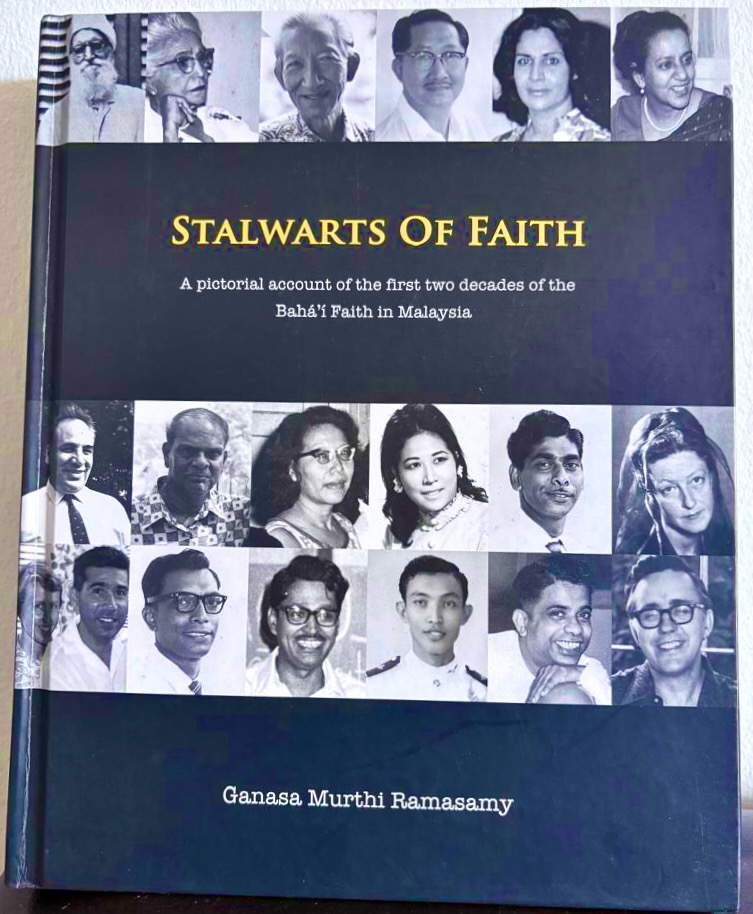
Ganesan’s book STALWARTS OF FAITH
Final Days
When Ganesan returned from the New Era High School in Panchgani, India in April 2006 he spent most of his time conducting classes on various Bahá’í topics at his home in Subang Jaya. He was also actively involved in vegetable farming on a small piece of land in front of his house. He developed excellent relationship in his neighbourhood, who knew him as a Bahá’í. He never failed to invite then for the Naw-Rúz parties held annually at his home. He gave away the plentiful produce to his neighbours and believers who visited him.
Ganesan had always health issues. Yet he attempted to write a biography on Mr. S. Nagaratnam, which he could not complete. In early 2021, in spite of his failing health, he started a study of the Dawn Breakers with a group of junior youth. During the fasting month in March 2021, he conducted classes on the story of ‘Abdu’l-Bahá over zoom technology for the children, well attended by Bahá’í children from Malaysia, Cambodia, India and the region. Sadly, he suffered a heart attack, and his soul winged its flight to the Abhá Kingdom on 29 April 2021 at the age of 74, plunging the Malaysian Bahá’í community into deep sorrow. His remains were laid to rest at the Bahá’í Memorial Park, Seremban in accordance to the Bahá’í burial rites.
An unmatched life of dynamism and driving force
It is truly mind-boggling to witness how one who accepted the Faith at a tender age, during the Ten Year Crusade, remained constantly and relentlessly in service until his last breath. From the moment of his acceptance, he never wavered; he always found time to contribute to the Cause. Whenever requested to be of service for the Faith, “No” was never his reply. There were days or weeks or even months when Ganesan had to go on working for the Cause until his energy was drained out, often escalating his health issue further. Yet Ganesan found an inner happiness within the sufferings he had to undergo on account of serving the Cause of the Blessed Beauty. This star servant has left a trail of continuous service that will surely be emulated by future generations. He undertook every task assigned to him, but went further: he was always on the lookout for new opportunities to serve. Often, he charted his own programs of service. His singleness of purpose and unswerving devotion marked him as an outstanding servant of Bahá’u’lláh, rising to heights of achievement few can attain.
Rarely have we seen a life so entirely immersed in Bahá’í activity, yet Ganesan stood out as a unique believer who served unrestrained, like the wind. His untimely passing is an irreplaceable loss for generations to come. It is a sincere conviction that Ganesan was shaped by the wondrous hands of Bahá’u’lláh to serve His Cause in areas less traveled by others. His life and legacy shall forever remain a profound inspiration and lesson for the current generation and those yet to be born.
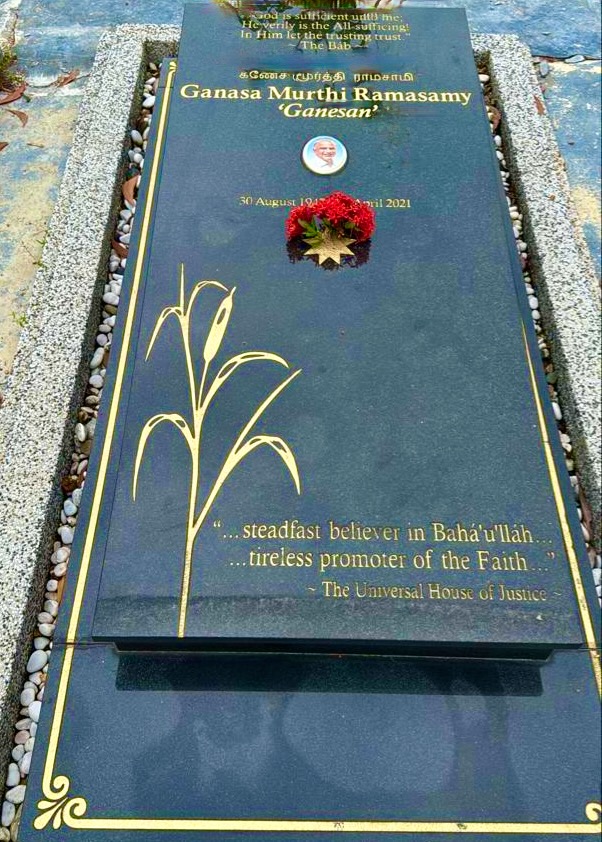
Whither can a lover go but to the land of his beloved?
– Bahá’u’lláh
A. Manisegaran
Copyright©bahairecollections.com
You may leave your comments at: info@bahairecollections.com